.svg)

.svg)


LinkedIn Is the #2 Most-Cited Source in AI Search: What It Means for Employee Advocacy
New Meltwater research analyzed 9.5 million AI citations across ChatGPT, Claude, Gemini, and Copilot. LinkedIn ranks #2 globally, and 75% of its citations come from individual profiles — not company pages. Here's what B2B marketers need to know.


Search is no longer just about ranking. When someone opens ChatGPT, Claude, or Copilot and asks which employee advocacy platform to use, which SaaS tool to consider, or how to build a brand ambassador program, the answer they get is shaped by what AI models have learned to trust. And new research reveals that LinkedIn has become one of the most trusted sources of all.
Meltwater, in collaboration with LinkedIn, analyzed 9.5 million AI citations across six major AI platforms: ChatGPT 5, Google AI Mode, Google AI Overviews, Gemini 3.5 Pro, Microsoft Copilot, and Claude Sonnet 4. The results offer a clear signal for B2B marketers: being active on LinkedIn is no longer just about audience reach. It's about becoming the answer AI gives.
The Numbers That Matter
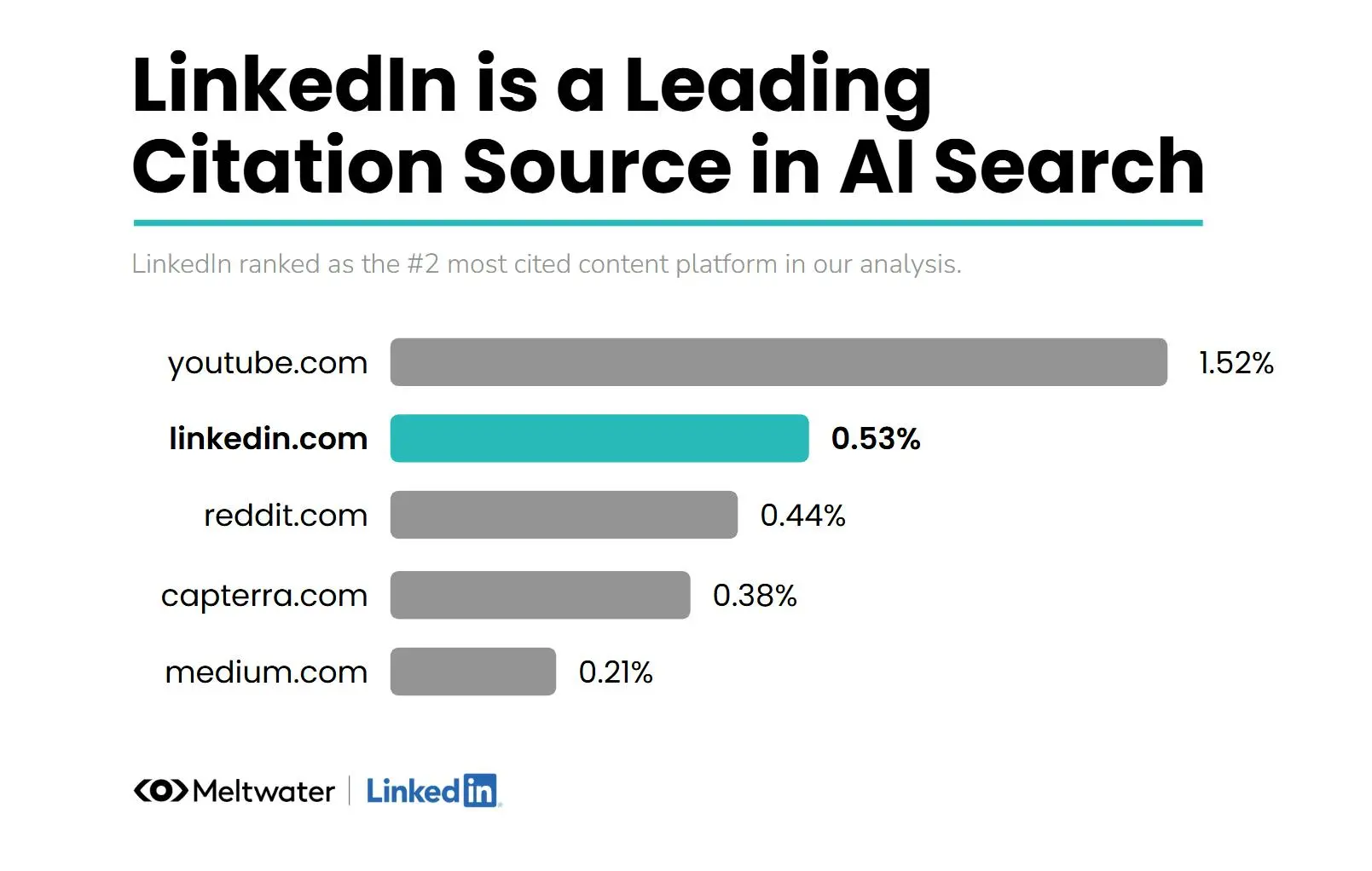
Out of 16 B2B categories analyzed, LinkedIn ranked #2 overall in AI citations, second only to YouTube. Here are the five findings that stand out most.
1. LinkedIn's citation share is growing fast
LinkedIn's share of AI citations grew 26% over just four weeks of research. As AI tools become the default starting point for business decisions, LinkedIn's presence in AI-generated answers is accelerating not holding steady.
2. Individuals get cited 3x more than company pages
Approximately 75% of LinkedIn citations came from individual member profiles, with only 25% coming from Company Pages. AI models trust real expertise over brand accounts. When credible professionals write about their field with examples, data, and personal experience AI platforms learn from them and reference them in future answers.
3. Structured content performs best
The top-cited LinkedIn articles shared a clear pattern. The most-cited posts consistently used:
- Bullet points and numbered lists (100% of top-cited articles)
- Clear H2/H3 section headings (92%)
- Specific company or tool names (75%)
- Hard numbers and data (67%)
- Comparison or evaluation frameworks (50%)
Vague thought leadership essays are rarely cited. Content that reads like a practical buyer guide, with a clear question, a direct answer, and decision criteria, is what AI systems learn from and reference.
4. UGC platforms dominate over company websites
User-generated content platforms, like LinkedIn, Reddit, and YouTube account for 47.5% of all AI citations. Company websites, by contrast, account for only 18.7%. This doesn't mean your own website is irrelevant. It means that AI tools actively look beyond owned channels for independent validation and real-world expertise.
5. Fresh, original content creates more opportunities
72% of AI-cited content was original (not reshared), and 48% was published in the previous three months. Consistency and recency matter. Organizations that maintain a regular publishing cadence on LinkedIn give AI models more material to work with and more recent material is weighted more heavily.
What This Means for Employee Advocacy
For organizations running employee advocacy programs, this research adds a new dimension to the ROI of LinkedIn activation. The traditional argument for employee advocacy has always been organic reach: more employees posting means more eyes on your brand. That argument still holds.
But Meltwater's findings add a second layer: employee activity on LinkedIn directly shapes how AI models perceive and present your brand.
When your team's subject matter experts, sales professionals, and customer success managers publish structured, credible content on LinkedIn about your product category, your clients' challenges and your market. They're not just building their personal brand. They're training AI to recognize your organization as a credible source of expertise.
Consider what happens when a prospect opens ChatGPT and asks: "What are the best employee advocacy platforms in Europe?" If your team members have been publishing consistently on this topic, comparing tools, sharing results, writing how-to guides, that content is far more likely to appear in the AI's answer than a polished press release ever would be.
The Practical Takeaway
The Meltwater research offers a concrete recipe for AI visibility on LinkedIn. Based on the findings, organizations should focus on:
- Building a bench of publishing experts — not one spokesperson, but multiple credible voices from different functions who each own a specific topic
- Publishing original content consistently — 2–3 posts per week per active advocate, with a mix of text posts and long-form articles
- Structuring content like a buyer guide — clear headings, bullet points, named tools and companies, data points, and comparison frameworks
- Focusing on decision-intent topics — "best X for Y", "how to choose between A and B", "what to look for when evaluating Z"
- Balancing individual voices with company page content — the 75/25 split shows individuals carry more weight, but a well-managed company page still contributes
For organizations already using a structured employee advocacy platform, the infrastructure is already there. The additional step is making sure the content strategy is optimized for AI citation — not just engagement metrics.
The Shift Is Already Happening
Meltwater's research tracked AI citations across ChatGPT, Claude, Gemini, Copilot, and Google AI Mode. These are the tools your prospects, customers, and partners are already using to make decisions. The brands that show up in those answers aren't spending more on ads. They're publishing more consistently, through more credible voices, on the platform AI trusts most.
As Meltwater's Chief Product Officer Chris Hackney put it in the report: "For the last twenty years, the job of a brand was to be discoverable. In an AI-first world, the job is to be the answer."
Employee advocacy has always been about reach. Now it's also about authority, the kind that AI recognizes.
Sources
Keep on reading...



Webinar: How Executive Profiling Drives Brand Success
Discover how to turn your leadership team into thought leaders on social media. Learn how to involve them in employee advocacy for maximum impact.


Locations
5386 LE Geffen
1016 EJ Amsterdam
03802 Alcoy (Alicante)
Follow us


