.svg)

.svg)


AI in Your LinkedIn Posts: How It Affects Your Reach in 2026
AI can help you write faster but does it hurt your LinkedIn reach? Based on the latest 2026 algorithm research, we break down what LinkedIn actually penalizes, what it rewards, and how to use AI without killing your organic reach.


AI in Your LinkedIn Posts: How It Affects Your Reach in 2026
AI writing tools are everywhere. They promise speed, consistency, and polished copy in seconds. But if you are using AI to write your LinkedIn posts, you may be asking the wrong question. The question is not whether AI can write your posts. The question is whether your posts, AI-assisted or not, are actually reaching the right people.
Based on LinkedIn's own official statement, the Algorithm Insights Report 2026 by Richard van der Blom (based on 1.3 million posts across 80,000+ profiles), and independent research into AI content performance, here is what you need to know.
What LinkedIn actually says about AI content
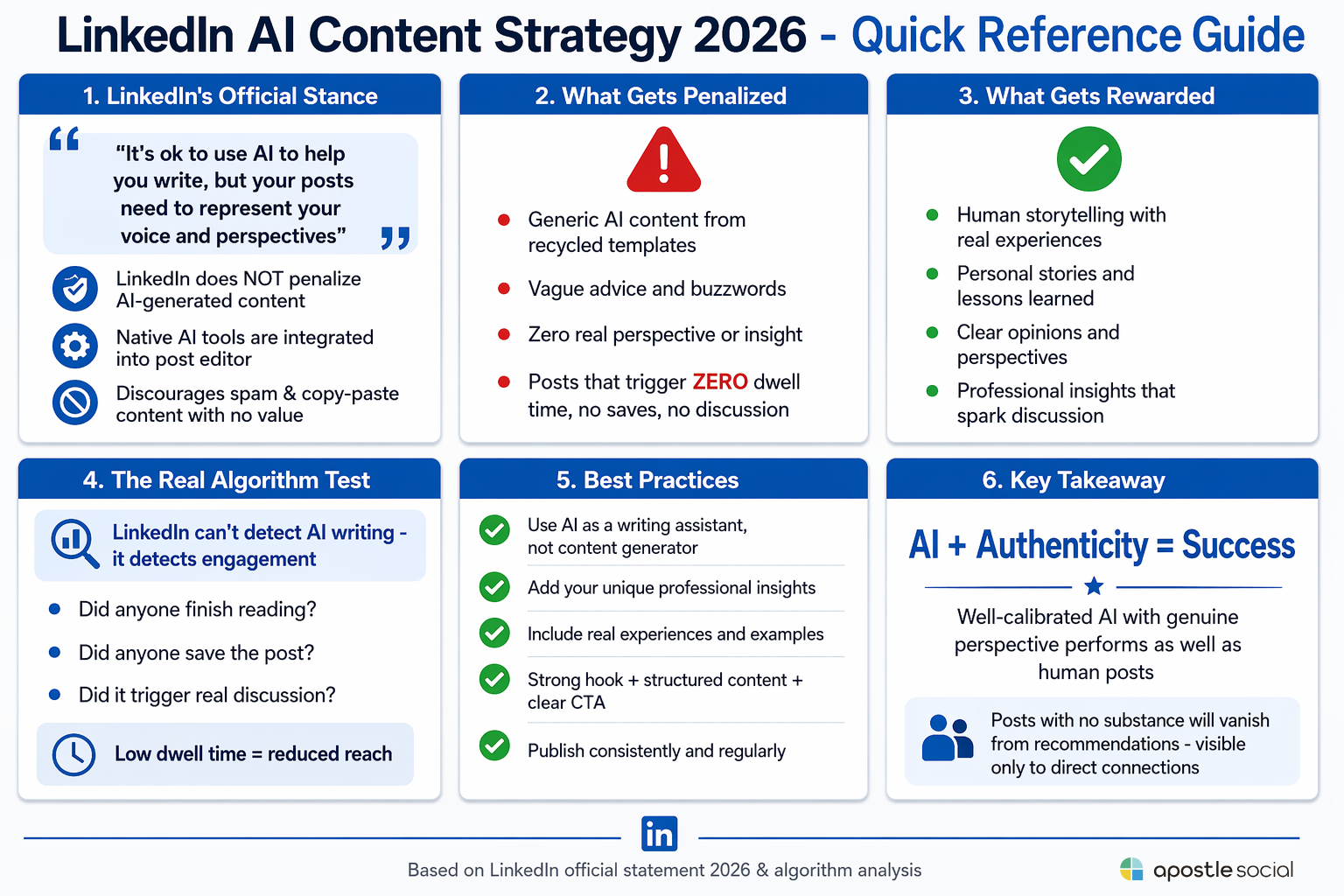
LinkedIn has made its position clear: "It's ok to use AI to help you write, but your posts and comments need to represent your voice and your perspectives."
The platform does not penalize AI-assisted content as a category. It has even integrated AI writing tools directly into its own post editor. What LinkedIn actively suppresses is something different: generic, recycled content that lacks a genuine point of view — regardless of whether a human or an AI wrote it.
In practice, this means a well-calibrated AI-assisted post with a real perspective, a strong hook, and relevant expertise can perform just as well as a fully human-written one. Some creators using AI have even seen their performance improve, because they publish more consistently.
The problem is not AI. The problem is filler.
What LinkedIn's algorithm actually detects
Here is the nuance that most people miss: LinkedIn's algorithm cannot reliably detect whether a post was written by AI. What it detects is whether anyone cared enough to keep reading.
The Algorithm Insights Report 2026 makes this explicit. LinkedIn moved from a Relationship Graph where your connections determined your reach to an Interest Graph, where topic relevance and engagement quality determine distribution. The algorithm evaluates every post through four simultaneous lenses:
- News Team: Is this timely and credible?
- Engagement Team: Does it generate real, substantive interaction?
- Trust & Safety Team: Is it authentic and human?
- Design & UX Team: Does it keep people on the platform?
AI-generated filler recycled templates, buzzword-heavy advice, posts with no specific insight fails the Engagement and Trust signals simultaneously. The result: near-zero dwell time, no saves, no real discussion, and a slow but measurable collapse in reach over time.
Posts that carry a genuine professional insight, regardless of how they were drafted, earn saves, comments, and extended dwell time. Those are the signals that trigger broader distribution.
The reach data: what is actually happening
Between February 2024 and August 2025, organic reach on LinkedIn dropped by more than 70% from its peak. The primary driver was LinkedIn's deliberate restructuring of its feed around the Interest Graph — rewarding topical clarity and genuine engagement over volume and network size.
Since September 2025, reach has stabilized and engagement has recovered up 18% above the September 2025 baseline by March 2026. But the recovery is not evenly distributed. Creators who post consistently within 2–3 defined topic areas, attract substantive comments, and earn saves are seeing the recovery. Those who kept posting generic content, AI-generated or not, are still waiting.
The data is clear: reach is no longer the right primary metric. Engagement quality is what the algorithm now rewards. A post with 30 deep comments and strong save signals consistently outperforms one with 200 quick reactions both in distribution and in business outcomes.
AI-generated images: a separate problem
The Algorithm Insights Report 2026 highlights an important finding on visual content. Personal, contextual photography consistently outperforms AI-generated images. Stock visuals have become a meaningful liability. AI-generated images perform variably but cannot match authentic photography in terms of engagement signals.
The reason aligns with the broader principle: audiences feel inauthenticity before the algorithm detects it. AI-generated images attract shallower comments and fewer saves the exact signals that determine whether a post gets extended distribution.
If a personal or contextual image is not available, a well-written text post will outperform a weak AI-generated visual every time.
The #1 performing topic on LinkedIn right now is AI itself
Here is a useful irony: while generic AI content underperforms, thoughtful content about AI is currently the highest-performing topic category on LinkedIn — with a median reach of 1,644 impressions and a 1.72x reach multiplier, according to the Algorithm Insights Report 2026.
AI content leads the entire dataset by a significant margin. The Interest Graph amplifies this topic aggressively because engagement quality is high: comments are substantive, saves are frequent, and the audience spans industries in a way few other topics can match.
The distinction matters: writing a generic AI post that could have been written by anyone earns nothing. Writing a specific, expert take on how AI is reshaping your industry with a real example, a data point, or a clear opinion earns disproportionate reach.
How to use AI without hurting your reach
The research points to a clear principle: use AI to draft and refine, but your experience, opinion, and examples must drive the substance.
Concretely, this means:
- Your insight first, AI's structure second. Start with a real observation, lesson, or data point from your own work. Use AI to sharpen the hook, tighten the structure, and improve readability not to generate the perspective itself.
- Avoid AI-generated openings. The hook is the single most important element of a LinkedIn post. It determines whether anyone clicks "See more" and that click rate is the first signal the algorithm scores. Generic AI openers ("In today's fast-paced world...") kill momentum before a single engagement arrives.
- Add specificity that AI cannot invent. A real client outcome, a specific number from your experience, a decision you actually faced — these are the signals that stop the scroll and trigger saves. AI cannot generate these for you.
- Engage authentically after posting. The first 60 minutes after a post goes live are disproportionately important. Responding to early comments, asking a follow-up question, and sustaining conversation are things AI cannot automate for you — and they are exactly what the algorithm is watching.
The bottom line
LinkedIn does not penalize AI-assisted content. It penalizes content without substance and AI makes it easier to produce content without substance at scale.
The creators gaining ground in 2026 are not the ones posting the most. They are the ones whose posts are topically consistent, genuinely useful, and specific enough to earn saves and real discussion. Whether AI helped draft those posts is irrelevant. What matters is whether a real professional insight is driving them.
Use AI as a writing tool, not as a thinking tool. The thinking, the perspective, the experience and the specific expertise has to come from you. That is what LinkedIn's algorithm is actually looking for. And in 2026, it is getting very good at finding it.
Keep on reading...



Webinar: How Executive Profiling Drives Brand Success
Discover how to turn your leadership team into thought leaders on social media. Learn how to involve them in employee advocacy for maximum impact.


Locations
5386 LE Geffen
1016 EJ Amsterdam
03802 Alcoy (Alicante)
Follow us


